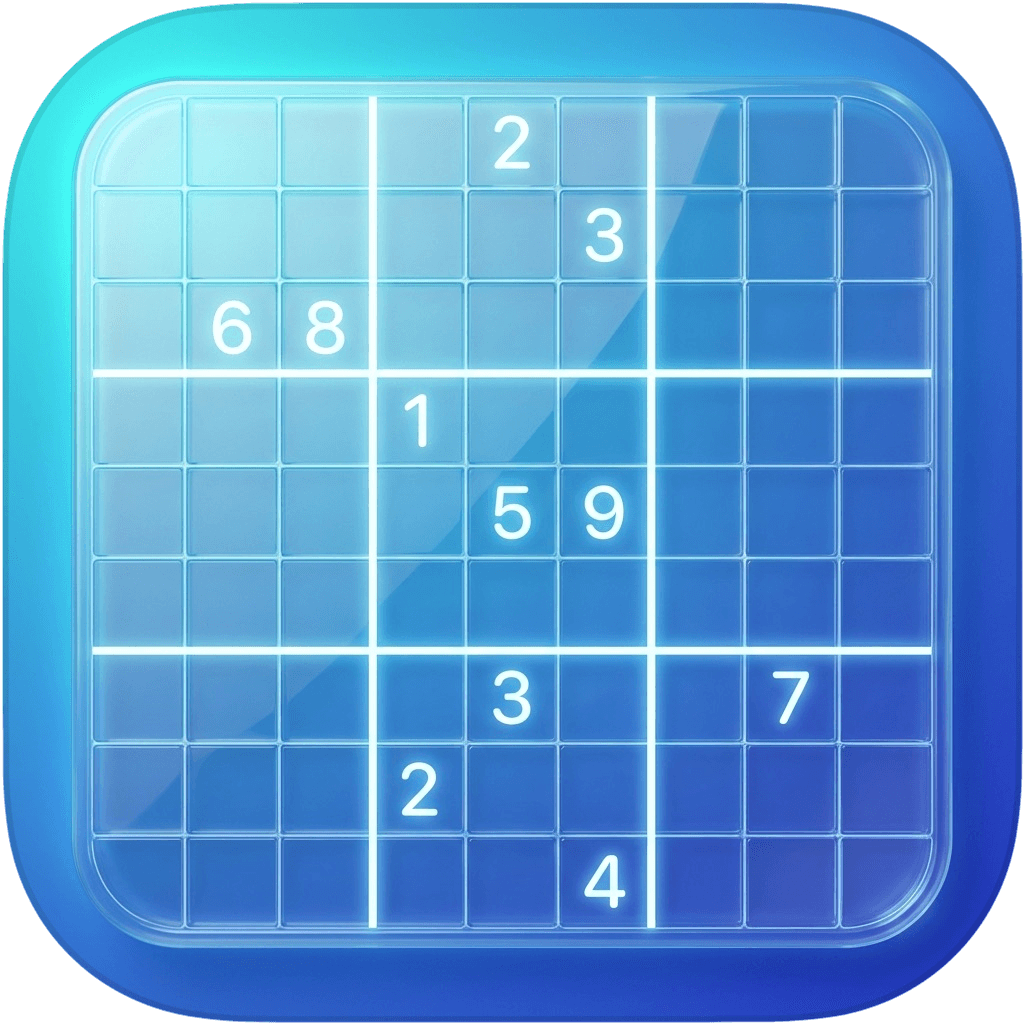
Sudoku is a logic-based number-placement puzzle played on a 9x9 grid divided into nine 3x3 boxes. The objective is to fill every empty cell with a digit from 1 to 9 so that each row, each column, and each 3x3 box contains every number exactly once. No mathematics is required — Sudoku is solved entirely through logical deduction.
What is Sudoku?
Sudoku (sometimes written "Su Doku") is the world's most popular pencil-and-paper puzzle. The name comes from the Japanese phrase sū ji wa dokushin ni kagiru, meaning "the digits must remain single." Despite its Japanese name, the modern form of the puzzle was designed by American architect Howard Garns and first published in 1979 under the name "Number Place." It gained worldwide popularity after appearing in The Times of London in 2004.
A standard Sudoku puzzle consists of a 9x9 grid, which is further divided into nine non-overlapping 3x3 sub-grids called boxes (also referred to as blocks or regions). At the start of the puzzle, some cells are pre-filled with numbers. These given numbers, often called clues or givens, provide the starting information needed to solve the puzzle. A well-constructed Sudoku always has exactly one unique solution.
Sudoku requires no arithmetic. The digits 1 through 9 serve purely as distinct symbols. You could replace them with nine letters, nine colors, or nine shapes, and the puzzle would function identically. What makes Sudoku compelling is the chain of logical deductions required to determine where each number belongs.
Sudoku Rules
The rules of Sudoku are simple and can be learned in under a minute. There are exactly three constraints, and every placement must satisfy all of them simultaneously:
- Row rule: Each of the nine horizontal rows must contain the numbers 1 through 9 exactly once. No number can repeat within a single row.
- Column rule: Each of the nine vertical columns must contain the numbers 1 through 9 exactly once. No number can repeat within a single column.
- Box rule: Each of the nine 3x3 boxes must contain the numbers 1 through 9 exactly once. No number can repeat within a single box.
These three rules are the only constraints in classic Sudoku. There is no time limit, no scoring based on speed, and no penalty for erasing. The puzzle is complete when all 81 cells are filled and every row, column, and box contains the digits 1 through 9 with no repetitions.
What makes a valid Sudoku puzzle?
A valid Sudoku puzzle must have exactly one unique solution. The number of given clues typically ranges from 17 (the proven minimum for a unique solution) to around 35 for easier puzzles. The difficulty of a Sudoku is determined not by the number of givens, but by the complexity of the logical techniques required to solve it.
How to Solve Sudoku (Step by Step)
Follow these steps to solve any standard Sudoku puzzle. These techniques work from the simplest to the more involved, and together they are sufficient to solve the vast majority of Sudoku puzzles rated easy through medium.
-
Understand the grid layout
Before writing anything, familiarize yourself with the grid. Identify the nine 3x3 boxes, the nine rows (horizontal), and the nine columns (vertical). Note which cells already contain given numbers. Each empty cell is the one you need to fill. -
Scan for naked singles
A naked single occurs when a cell has only one possible candidate. Look at an empty cell and check which numbers already appear in its row, column, and box. If eight of the nine digits are already present across those three groups, the remaining digit is the answer. This is the most fundamental solving technique. -
Use pencil marks (candidates)
For cells where more than one number is possible, write small candidate numbers in the corners or margins of the cell. These pencil marks help you keep track of possibilities and make patterns easier to spot. Many Sudoku apps, including Sudoku - Brain Puzzles, offer a built-in notes mode for this purpose. -
Look for hidden singles
A hidden single is a number that can only go in one cell within a particular row, column, or box, even though that cell may have multiple candidates. For example, if the number 7 can only fit in one cell within a box (because all other empty cells in that box already see a 7 in their row or column), then 7 must go in that cell. -
Eliminate candidates systematically
Each time you place a number, immediately update the pencil marks in the affected row, column, and box by removing that number as a candidate from all related cells. This elimination often reveals new naked or hidden singles. -
Repeat until the grid is complete
Continue scanning, placing numbers, and eliminating candidates. Work through each row, column, and box methodically. With patience, the grid will gradually fill until every cell contains a number and the puzzle is solved.
Beginner Tips
These practical tips will help you build good habits and solve puzzles more efficiently as you learn:
- Start with easy puzzles. Easy puzzles can be solved almost entirely with naked and hidden singles. They build your pattern recognition and confidence before introducing more complex techniques.
- Work one number at a time. Pick a single digit (for example, 5) and scan the entire grid for where it can and cannot go. This "cross-hatching" approach is faster than examining cells randomly.
- Always use pencil marks. Even experienced solvers use candidates. Trying to keep possibilities in your head leads to errors. Write them down.
- Focus on constrained areas. Rows, columns, or boxes with only two or three empty cells are the easiest to complete. Target these first.
- Take breaks when stuck. If you have been staring at the grid for several minutes without progress, step away briefly. Fresh eyes frequently spot what tired eyes miss.
- Never guess. Sudoku is a logic puzzle, not a guessing game. If you are unsure about a placement, you have not found the right logical deduction yet. Keep scanning for eliminations and patterns.
- Practice daily. Like any skill, Sudoku improves with regular practice. A daily puzzle habit helps you internalize common patterns and speeds up your solving time.
Common Mistakes to Avoid
Beginners tend to make the same handful of mistakes. Being aware of these pitfalls will save you frustration:
- Placing a number without checking all three constraints. It is not enough to verify the row alone. Every placement must satisfy the row, column, and box simultaneously. A number that looks valid in a row may already exist in the same column or box.
- Forgetting to update pencil marks. After placing a number, always go back and erase that number from the candidates in the same row, column, and box. Stale pencil marks are the leading cause of errors in partially solved grids.
- Guessing instead of deducing. If you place a number based on a hunch rather than a logical deduction, any mistake will cascade through the grid and may not become apparent until much later. If no certain placement is available, look harder for eliminations.
- Overlooking hidden singles. Beginners often focus exclusively on naked singles and miss hidden singles, which are equally important. Always check whether a number has only one possible cell within each row, column, and box.
- Trying to solve too fast. Speed comes with practice, not with rushing. Accuracy is always more important than speed. A single wrong number can make the puzzle unsolvable.
- Starting with hard puzzles. Difficult puzzles require advanced techniques like naked pairs, pointing pairs, X-wings, and more. Jumping straight to hard puzzles as a beginner leads to frustration. Build up gradually from easy to medium to hard.
Frequently Asked Questions
What are the rules of Sudoku?
Sudoku has three rules: every row must contain the numbers 1 through 9 exactly once, every column must contain the numbers 1 through 9 exactly once, and every 3x3 box must contain the numbers 1 through 9 exactly once. No guessing is required — every valid Sudoku puzzle can be solved through logic alone.
Is Sudoku a math game?
No. Although Sudoku uses numbers, no arithmetic is involved. It is a pure logic puzzle. The digits 1 through 9 are simply symbols used to represent nine distinct values. You could replace them with letters, colors, or shapes, and the puzzle would work identically.
How long does it take to learn Sudoku?
Most people can learn the basic rules in under 5 minutes. Solving an easy puzzle typically takes 10 to 20 minutes for a complete beginner. With regular practice over a few weeks, most players can comfortably solve medium-difficulty puzzles and start developing faster solving times.
Can Sudoku puzzles have more than one solution?
A properly constructed Sudoku puzzle has exactly one unique solution. If a puzzle allows multiple valid completions, it is considered poorly designed. Reputable sources and apps, such as Sudoku - Brain Puzzles, guarantee that every puzzle has a single, logically deducible solution.